
After 5 years of homeownership, I had determined my Net Ownership Cost. Now, after 10 years, I sold that home and have updated values based on my real-world experience. In 2026, I decided to downsize from a single-family home to a centrally located townhome in the same city. While my house appreciated by $100k, 32% over the 10.5 years (average annual rate of 2.7%), my ownership costs over the same period were $157k. When factoring in the selling & moving costs ($13k) and the forfeited gains from the $100k down payment made at purchase, my Net Ownership Cost for the 10.5 years was $193,698 ($1,537/month). It should be noted that my selling costs were discounted since my realtor was handling both the sale of my single-family home and the purchase of the townhome.
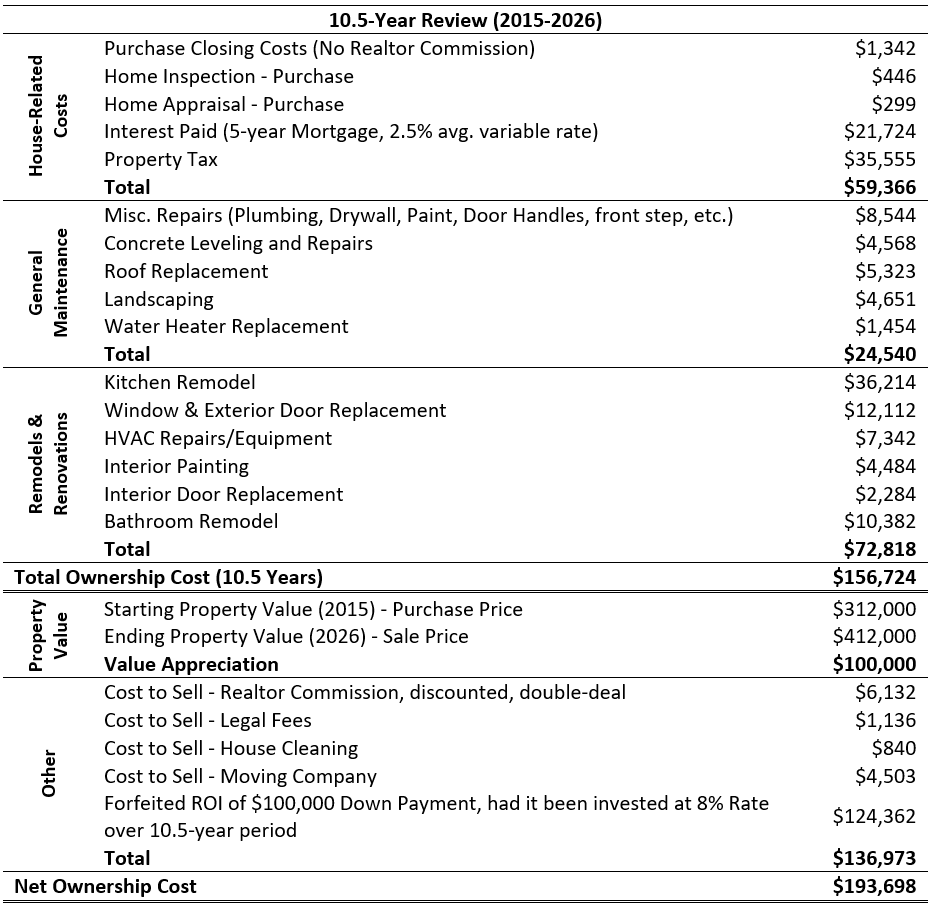
When comparing to my 5-year ownership costs, my average monthly cost decreased from $2,215 to $1,537. This is largely due to large expenditures like remodels and upgrades, as well as fixed buying and selling costs, being spread out over a longer period. I had determined that after 5 years of homeownership, I would have saved money (~$215/month) by renting an equivalent home. However, that conclusion reverses when extending the period to 10 years. Using the same values and assuming a 2% annual rent increase, homeownership was $654/month cheaper than renting, over $82k over the 10 years – see chart below for the comparison.
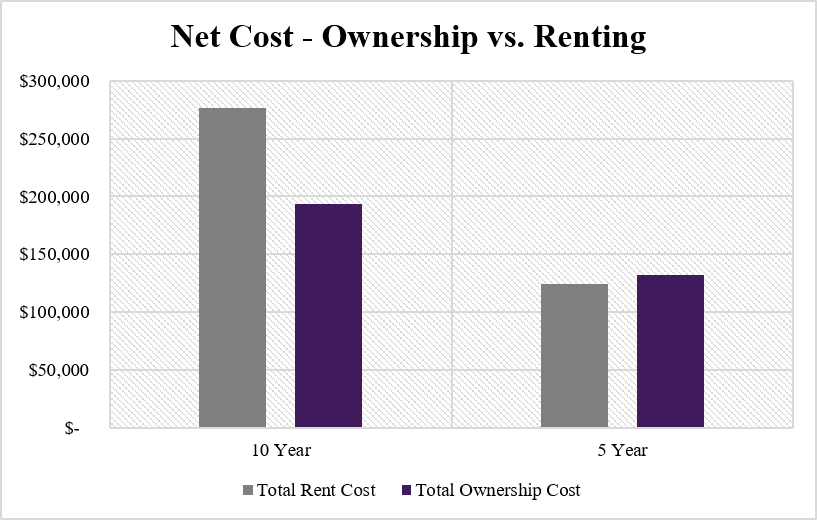
My real-world experience supports the common advice, and general ‘rule of thumb’, to only purchase a home if you plan to keep it for more than 5 years.
I had an interesting experience when I went to the bank to deposit the $412,000 cheque for the sale of the house. After telling the Bank Twhat the money was for, he asked me how much profit I made from the home. I wasn’t sure what he was referring to – I responded that the house had cost me some $194k, nowhere close to profitable, and he seemed just as puzzled by my response as I was by his question. It seemed as though his customers usually profit from homeownership, but I’m down almost $200k! When I returned home, I searched for the common definition and calculation for homeownership profit, and I found the formula
Net Profit = Sale Price – (Purchase Price + Improvement Costs + Buying&Selling Costs + Holding&Ownership Expenses)
When I enter my values into this formula, it returns the following:
Net Profit = $412,000 – ($312,000 + $72,818 + $59,366 + 136,973 + $24,540)
Net Profit = -$193,698
So, it seemed my definition of profit aligns, but why was the Bank Teller so surprised to hear that I had lost money instead of profiting? I will never know for sure, but my assumption is that most people don’t use the same definitions when speaking. I recall a friend of mine once told me that he was profiting some $50k from his home sale, but when I questioned him on how he came to that number, I realized that he was referring to the Net Proceeds (the balance after paying off his mortgage and selling costs). Perhaps the Bank Teller was asking about Net Proceeds when asking about my profit.
Net Proceeds = Sale Price – (Mortgage Payoff + Agent Commissions + Legal Fees + Other Selling Costs)
Net Proceeds = $412,000 – ($0 + $6,132 + $1,136 + $5,343)
Net Proceeds = $399,389
There’s a big difference between the Net Profit (-$194k) and Net Proceeds ($399k), and it’s therefore important to define metrics when speaking about these terms. It’s not only with home costs that definitions are important. I frequently raise financial topics with friends, family, and colleagues, and realize that people use a wide range of different definitions when speaking about personal finance. A common example is not thinking that a mortgage is debt, or not including the value of retirement investments or business equity in a net worth calculation. Refer to this Net Worth post for helpful tips to calculate your Net Worth.


Leave a Reply