
English philosopher Bertrand Russel famously said, “The whole problem with the world is that fools and fanatics are always so certain of themselves, but wiser people so full of doubts” (Carney, 2021). It is a natural human characteristic to have confidence in matters when understood only at a high level. It seems that the more you study a subject, the more nuance you uncover, and the more complicated the matter becomes.
When interviewing an individual for an administrative position a few years ago, I asked them what their level of proficiency was with Microsoft Excel, a software program this individual would be using daily. Personally, having used Excel for 15 years and taking several intermediate and advanced courses for it, I am humbled by the program’s abilities, and I would not rate myself much higher than 2 out of 5 (intermediate) on a 5-level proficiency scale. The candidate confidently told me that they had an advanced level of proficiency, likely 4 out of 5, and that they had been using Excel for many years. Because they were so confident in their response, I took them at their word. After hiring the individual, I realized quickly that they were operating at a novice level of proficiency, a 1 of 5. When I questioned them about the issue, it became clear that they only had a very surface-level understanding of the program’s capabilities. So, to them, they were very good with Excel, but only with the very simple tasks that they had been exposed to.
The disconnect between one’s perceived competence and their actual competence is known as the Dunning-Kruger effect. As shown in teh chart below, perceived competence is highest when actual competence is lowest. It is only once someone becomes more competent that they begin to understand how limited their competence really is.
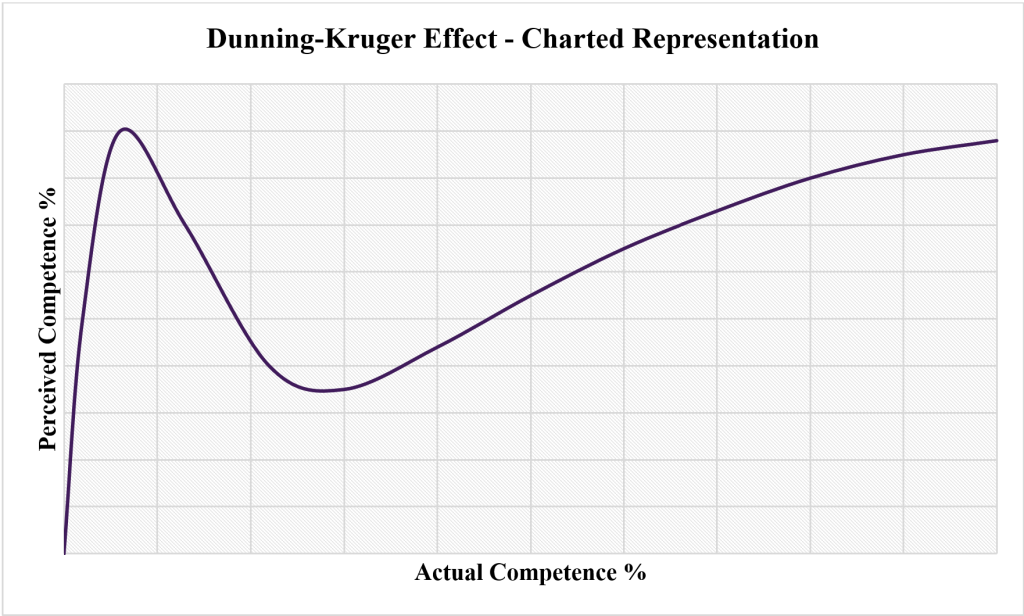
French author André Gide famously wrote, “Trust those who seek the truth but doubt those who say they have found it” (Carney, 2021), which can be interpreted as a warning about the cognitive bias we now call the Dunning-Kruger effect. Be wary of those who are overly confident; it is likely that they are not as competent as you expect them to be (or as they believe they are).
References:
Carney, M. (2021). Value(s): Building a better world for all (Hardcover edition). Signal, an imprint of McClelland & Stewart.

 Fiscal Paradigm
Leave a reply to Rewarding Confidence over Competence – Fiscal Paradigm Cancel reply