
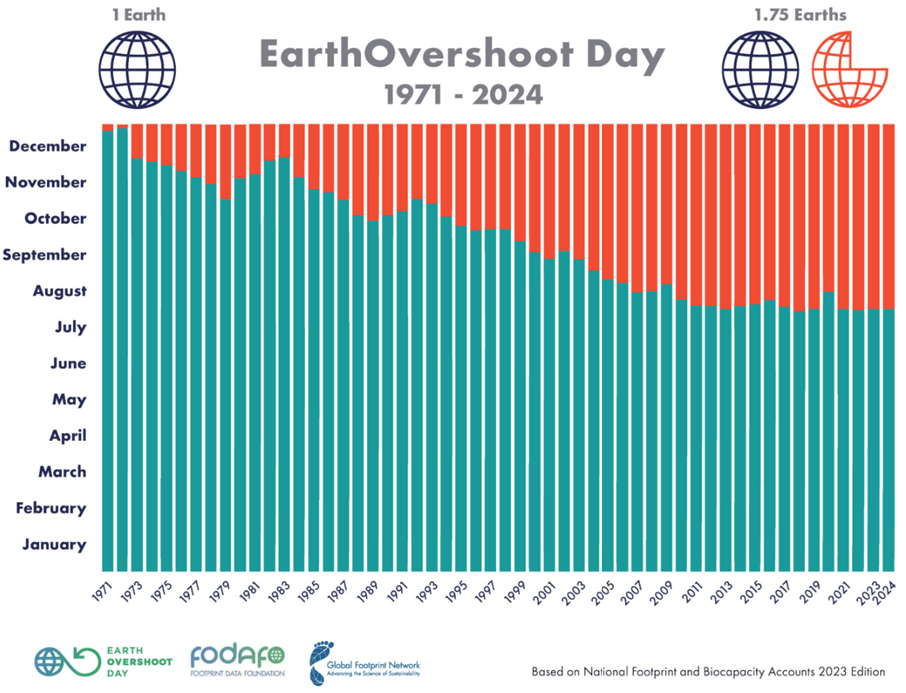
Earth’s Biocapacity is the total regenerative capacity of the planet’s ecosystems, including crops, grazing lands, forests, and fishing areas. The Ecological Footprint is the global population’s demand for agricultural products, livestock and fish, timber and forest products, and urban space (Ecological Footprint, 2024). 1971 was the first year when Earth’s Ecological Footprint exceeded its Biocapacity, meaning that the Earth was not able to regenerate the population’s demand on its biocapacity. Every year since, Earth has been running in an ecological deficit. Earth Overshoot Day is the day of the year when global demand has exceeded the Earth’s yearly biocapacity; in 2024, Overshoot Day was August 1st (Earth Overshoot Day, 2024). The planet’s current demand is equivalent to 1.75 Earths worth of yearly biocapacity! Each country, however, has its own Ecological Footprint (i.e., demand). Switzerland, for example, is a very wealthy nation with high consumption. If everyone in the world lived like the Swiss, it would take 2.5 Earths to support humanity (“Country Overshoot Days,” 2024)!
Figure 6 Historical Earth Overshoot Days (Earth Overshoot Day, 2024)
The Global Footprint Network – those behind Earth Overshoot Day – proposes some solutions to reduce the demand on Earth’s biocapacity. They suggest that we can reduce Earth Overshoot Day by:
- 13 Days – if we replace 50% of our driving with a combination of public transit, biking, and walking.
- 93 Days – if we reduce the carbon elements of humanity’s ecological footprint.
- 21 Days – if we adopted and implemented currently available energy-efficiency technologies for buildings, industrial processes, and electricity production.
- 17 Days – if we replaced 50% of global meat consumption with vegetables.
- 13 Days – by global reducing food waste by 50%.
- 8 Days – by reforesting 350 million hectares of forest.
- 49 Days – if every other family had one less child and parenthood was postponed by two years.
While this is a site dedicated to financial matters, it is important to understand that many items that we choose to spend more money on also negatively impact the environment. For example, driving is more costly than public transit both in terms of financial and environmental costs. Similarly, calories from meat are more expensive than calories from vegetables, and meat production is also worse for the environment. With this knowledge and information, you can consider how your everyday actions are impacting the planet and your pocketbook.
References
Country Overshoot Days. (2024). Earth Overshoot Day. https://overshoot.footprintnetwork.org/newsroom/country-overshoot-days/
Earth Overshoot Day. (2024). Earth Overshoot Day. https://overshoot.footprintnetwork.org/
Ecological Footprint. (2024). Global Footprint Network. https://www.footprintnetwork.org/our-work/ecological-footprint/
 Fiscal Paradigm
Leave a comment