
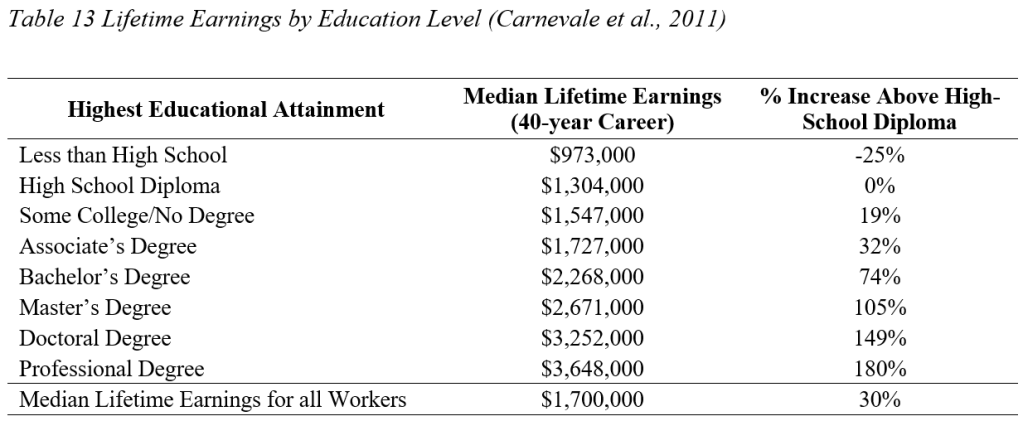
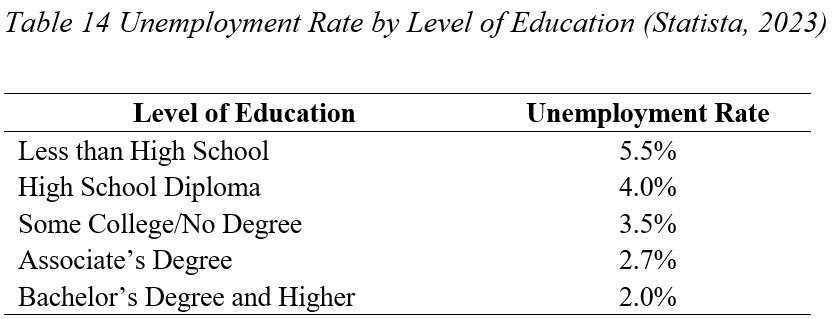
Post-secondary education is generally worthwhile and earning potential increases with educational attainment. Table 13 below shows data from Carnevale et al. (2011) and indicates that over a forty-year career, someone with a master’s degree will have earned more than twice as much as someone with only a high school education. And those with a professional degree will earn around $1 million more than a master’s degree holder will. Not only do degree holders earn more, but they’re also more employable. According to Statista (2023), the unemployment rate decreases with the level of attained education, too (see table 14 below).
So it sounds like going to college is all positive, right? Well, not all post-secondary education is marketable or worthwhile from a financial perspective. It is important to consider where your degree will take you. You should have an idea of the wages, career outlook, and working conditions before spending years (and money) studying a major that may not be marketable. By marketable, I am referring to the ability of the degree to lead to stable employment that pays well. You don’t want the surprise of learning upon graduation that you are not able to find employment in the field you studied, or that it pays less than you expected, or that you need to move across the country for career opportunities.
Career Outlook: Is this career field growing or shrinking? You will not want to specialize in a field that is shrinking since it may be difficult to find work or establish a long-term career. You will want to find a field of study that will lead you into an occupation with growing demand. According to the U.S. Bureau of Labor Statistics (2023), the top growing occupations between 2022 and 2032 are projected to be Wind Turbine Service Technicians, Nurse Practitioners, and Data Scientists. Contrarily, the fastest declining occupations include Word Processors & Typists and Watch and Legal Secretaries & Administrative Assistants. The full dataset can be viewed & downloaded here at the link in the References section below.
Working Conditions: You will want to ensure that the career field in which you plan to enter is likely to meet your expectations of working conditions. Working schedules, travel requirements, and physical requirements should all be known before choosing a specific career path. For example, a career in nursing usually requires working for long hours while standing, and shift work, which means working nights and weekends. If you are looking for an 8-5 Monday to Friday office job, the working conditions offered by a nursing degree may not be well-suited. Occupations in the aviation industry – like pilots and flight attendants – offer the opportunity to travel which may be appealing to those who do not want the consistency of an office job. Engineers in the manufacturing, construction, and energy industries are often required to visit work sites which can be in remote parts of the world and challenging environments (e.g., dirty, dusty, cold, wet, noisy, etc.). After graduating from my mechanical engineering program in 2010, I joined an energy services company which led me to work as a field engineer in the 45℃ heat in the outback of Australia, the -40℃ cold of the Canadian north, and offshore in the Arabian gulf of Abu Dhabi which is only accessible by helicopter. My point is that spontaneous and somewhat risky travel and working conditions come with the territory when working as a field engineer in the energy industry, and it is not for everyone.
Return on Investment: You will want to ensure that the career field you choose is going to compensate you enough to make the investment in the degree worthwhile. The lifetime return on investment (ROI) of a degree is determined by comparing the average lifetime earnings in the career field to the lifetime financial investment into the degree. Different degrees offer different ROIs; a Computer Science Major offers the best ROI, while Fine Arts degrees have a negative ROI (Hanson, 2021). A list of ROI by degree type is available in the Reference section below.
Not only must you select a major with a positive ROI, you should not over-pay for your degree. The cost of your degree will vary drastically between institutions, depending on whether you are studying locally, out of state, out of the country, at a private university or on a prestigious campus like one of the Ivy Leagues’. By assessing the costs and incomes graduates will achieve from their degrees at public, private, and Ivy League schools, Brownlee (2023) determined the net present value (NPV) of four-year degrees and the rate of return (ROR). The resulting consensus is that public schools offer a higher ROR than both the private and Ivy League schools at 51.6%, 44.6%, and 44.6%, respectively. Brownlee (2023) also concluded that the degree cost-to-salary ratio for the public schools was half that of the Private and Ivy Leagues at 1.56, 3.06, and 3.46, respectively. Of course, there are exceptions, but generally, you get more bang for your buck with a public school.
Transferability and Accreditation: Is your degree in a field where accreditation is important to employers? Are you planning to work abroad, and if yes, will your degree credentials be recognized in that country? You don’t want the surprise that your specialization is not recognized in other provinces, states, or countries in which you plan to work. If accreditation and international recognition are important to your future career, be sure to research the topic before committing time and money to a degree that may not suit your needs. I witnessed this issue when attending university in Canada with some mature students who had moved to Canada from their native country and realized that their master’s degree in engineering was not recognized in Canada, causing them to restart their education all over again later in life.
Big Decisions: It is difficult to expect high school kids aged 16 and 17 to make a thoughtful decisions about their career path and education which will impact the rest of their lives. If you are at the stage of deciding what to study in university and are unsure, a more general degree such as Business Administration offers students universal skills and knowledge that are transferable to many types of businesses. In business school, students learn accounting, finance, marketing, ethics, operations, and other subjects which apply to all industries and can lead to various non-specific career paths that offer differing working conditions and career outlooks.
References:
Brownlee, A. P. (2023, February 8). Is an Ivy League Degree Worthwhile? Investopedia. https://www.investopedia.com/articles/personal-finance/112815/ivy-league-degree-worth-it.asp
Carnevale, A. P., Rose, S. J., & Cheah, B. (2011). The College Payoff: Education, Occupations, Lifetime Earnings. In Georgetown University Center on Education and the Workforce. Georgetown University Center on Education and the Workforce. https://eric.ed.gov/?id=ED524299
Hanson, M. (2021, November 19). Is College Worth it? | Return on Investment Analysis of College Degree. Education Data Initiative. https://educationdata.org/college-degree-roi
Statista. (2023, November 3). Unemployment rate by education U.S. 2022. Statista. https://www.statista.com/statistics/232942/unemployment-rate-by-level-of-education-in-the-us/
U.S. Bureau of Labor Statistics. (2023, September 6). Fastest declining occupations: U.S. Bureau of Labor Statistics. Employment Projections. https://www.bls.gov/emp/tables/fastest-declining-occupations.htm
 Fiscal Paradigm
Leave a comment