
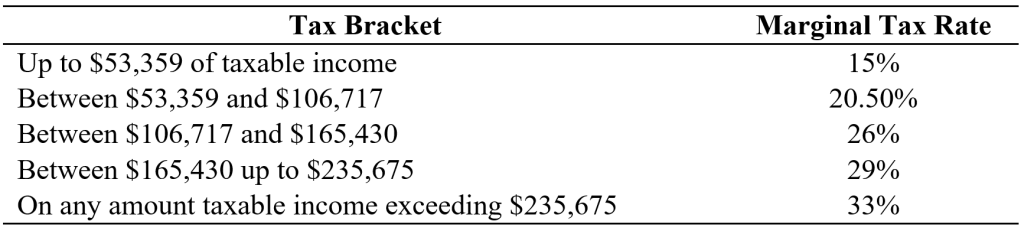
Over the years, I have witnessed a common misconception about how income tax brackets work. In Canada, income taxation is progressive, which means that the tax rate increases the higher your income. The rungs on the proverbial taxation ladder are called tax brackets. The Table below is an example of the Canadian Federal Tax Brackets for 2023. The Marginal Tax Rate is only applied to the amount that falls within the Tax Bracket. For example, someone who earns $75,000 per year will owe 15% on the first $53,359 ($8,003.85 in tax) and 20.5% on the next $21,641 ($4,436.41 in tax), totaling $12,440.26 in federal taxes owed. The average federal income tax rate – calculated by dividing the tax owed ($12,440.26) by the gross income ($75,000) – is 16.6%. So, what is the misconception? Some people believe that your entire income is taxed at the marginal tax rate of the bracket in which your income falls. I have heard several anecdotes of people who have opted to forego a raise or promotion to avoid their income reaching a higher tax bracket, which is a terrible mistake.
Table: Canadian Federal Tax Brackets, 2023 (Fidelity, 2023)
It should be noted that the above example only discusses federal income tax brackets. Each Canadian province has its own provincial income tax rates that may include its own tax brackets and Marginal Tax Rates that do not align with the federal brackets. The same logic applies for both Federal and Provincial – you only pay the Marginal Tax Rate for the amount that falls within the Tax Bracket. To determine your average tax rate, marginal tax rate, and payable income tax, check out https://www.ey.com/en_ca/tax/tax-calculators.
References:
Fidelity. (2023, February 15). 2023 Canadian income tax brackets. https://www.fidelity.ca/en/insights/articles/2023-canadian-income-tax-brackets/
 Fiscal Paradigm
Leave a comment